

Embracing Open Source AI: How Businesses Can Benefit from Open Source LLM Solutions
Open source AI is transforming how businesses approach innovation. Once dominated by costly, closed systems, the AI landscape is now open to everyone, from startups to global enterprises. Open-source Large Language Models (LLMs) like Llama, Mistral, and Qwen empower organizations to deploy powerful, customizable AI solutions without the burden of licensing fees, data privacy concerns, or vendor lock-in.
This article explores how open source AI enables cost efficiency, transparency, and control, highlights real-world use cases, and provides a practical roadmap for adoption, customization, and scaling. Whether you’re a CTO or a leader exploring AI integration, this guide shows why we believe that the future of AI is open and how your business can benefit.
Embracing Open Source AI: The Story of Accessible Innovation
A few years ago, Reagan, the CTO of a mid-sized logistics company, first explored AI with the excitement of a pioneer. She imagined smarter route planning, automated customer support, and predictive maintenance.
But reality hit quickly, the most advanced AI models were locked behind expensive paywalls, opaque architectures, and limited customization options. “It felt like renting someone else’s brain,” she joked, “but never being allowed to teach it what we knew.”
Everything changed when open source LLMs entered the scene. With Llama and Mistral, Reagan’s team built internal prototypes, trained them on their own delivery data, and deployed models securely in their private cloud, all at a fraction of the previous cost.
Her company wasn’t alone. Across industries, open source AI is now helping businesses innovate freely, cut costs, and retain ownership of their data, ushering in a new era of accessible, transparent, and customizable intelligence.
1. The Rise of Open Source AI Models
The AI ecosystem was dominated by closed platforms like OpenAI’s GPT, Anthropic’s Claude, and Google’s Gemini. These tools were powerful, but often restrictive.
Then came the open source revolution. With the release of models like Llama (Meta), Mixtral (Mistral AI), Qwen (Alibaba), and Falcon, businesses discovered that open source models could rival, and sometimes outperform, proprietary ones.
This democratization of AI has leveled the playing field, giving companies of all sizes the power to experiment, innovate, and deploy advanced AI systems at their own pace and scale.
2. Why Businesses Are Turning to Open Source AI
a. Cost Efficiency and Freedom from Licensing
Closed AI systems often come with per-token billing and recurring fees. Open source models can be hosted on-premises or in private clouds, eliminating those costs.
For Reagan’s logistics firm, switching to open source cut operating expenses by over 70%, freeing up budget for research and staff training.
b. Customization and Control
Every business is unique and so should its AI.
A financial institution, for example, fine-tuned Llama 3 on its internal compliance documents. The model began answering policy-related questions with near-human precision, reducing manual review time by 40%.
Such domain-specific tuning is rarely possible in closed systems.
c. Transparency and Trust
Most open source models are built on transparency. Businesses can review their architecture, understand training data sources, and audit outputs for bias or compliance, a crucial advantage in regulated industries like finance, healthcare, and public services.
d. Vendor Independence and Security
Relying on third-party AI APIs may expose sensitive data and create dependencies.
For instance, a global supply chain company found itself limited by third-party APIs that required sharing sensitive logistics data. Moving to Qwen 2 in its own private cloud eliminated those risks, giving the company full control over updates, compliance, and data protection.
3. Open Source AI: The Great Equalizer
A few years ago, AI felt like a privilege reserved for tech giants, expensive, complex, and out of reach for most. Smaller businesses could imagine the possibilities but not afford to explore them.
That story is changing. Open source AI has become the great equalizer, giving small and mid-sized companies the same tools once limited to billion-dollar labs. With models like Llama 3 and Mistral, teams can now experiment freely, no usage fees, no vendor lock-ins, just creativity and control.
Developers collaborate across GitHub, share tutorials, and build together. Tools like LangChain, Hugging Face, and Ollama help companies deploy prototypes in days, connecting AI directly into their CRMs, ERPs, and analytics platforms.
“We now have the ability to manufacture intelligence,” said NVIDIA CEO Jensen Huang – and open source AI is proof of that vision in action.
Industries once considered “too traditional” for AI are now leading the change. From law firms and factories to logistics networks, open source AI is transforming how work gets done, analyzing documents, automating workflows, and helping teams make smarter decisions every day. Open source hasn’t just opened technology, it has opened opportunity.
4. Top Open Source LLMs for Business
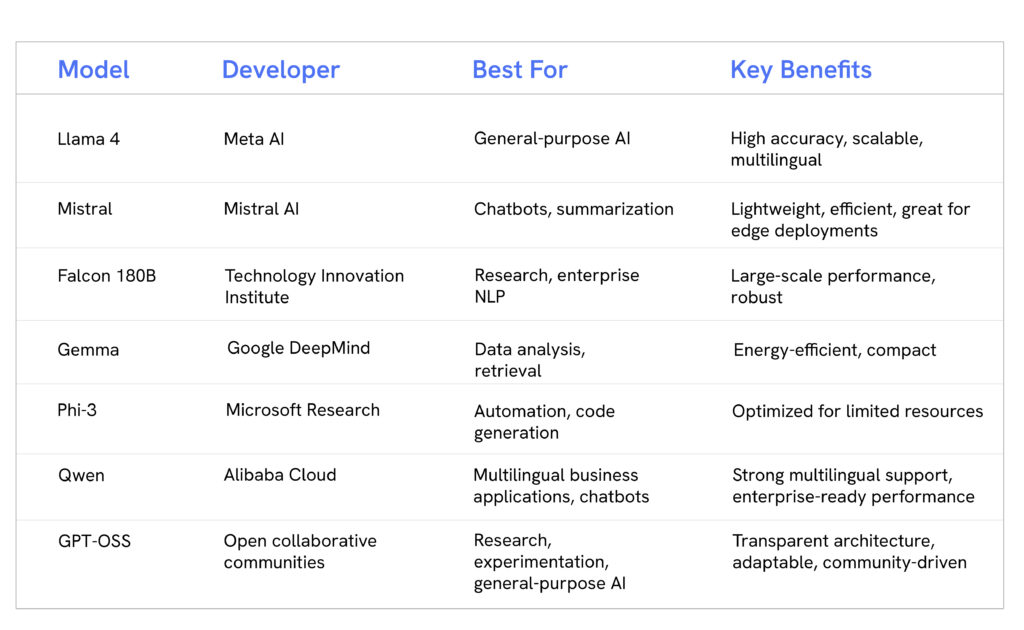
5. Customizing Open Source Models for Real Business Impact
Every business has its own language, processes, and data. Closed source tools often miss that context, but open source AI makes true customization possible.
That’s exactly what a European insurance firm did. Using open source AI, the company fine-tuned Qwen 2 on its historical claim records. Within weeks, the model learned to process complex cases, highlight anomalies, and forecast outcomes with impressive accuracy.
By applying LoRA adapters for low-cost customization and integrating the AI into their internal system, the firm cut processing times from 40 minutes to under five. More than efficiency, they gained control, building an AI that understood their business, not just generic data.
6. Scaling with Open Source Enterprise LLM Solutions
It often starts small. But as adoption spreads across departments, the AI workload multiplies. Suddenly, the question isn’t “Can we use AI?” – it’s “Can our AI keep up?”
That’s where open source makes all the difference.
Companies can scale horizontally by running multiple AI instances using Kubernetes or Ray, or vertically by moving from smaller models to enterprise-grade ones like Llama 3 or Qwen 2. The best part? Costs remain predictable, tied to compute capacity rather than rising API usage. And as open source models evolve constantly through global collaboration, their performance keeps getting better.
With frameworks like LangChain, LlamaIndex, and Haystack, businesses can now build end-to-end AI pipelines, for search, summarization, and knowledge management, all within their own secure enterprise environments.
7. The Future of Business AI Is Open
The momentum behind open source AI is unstoppable. Governments, startups, and Fortune 500 companies alike are turning to open solutions for transparency, adaptability, and sovereignty.
Open source ensures that innovation stays collaborative and accessible, allowing every business to build AI aligned with its goals, not dictated by external vendors.
For leaders like Reagan, embracing open source wasn’t just a technical decision, it was a strategic one. It meant taking back control, building internal expertise, and future-proofing her organization’s innovation pipeline.
Conclusion
The shift toward open source AI marks a turning point in enterprise technology.
By adopting models like Llama, Mistral, Qwen, or Gemma, businesses can build intelligent systems that are cost-effective, transparent, and scalable.
This isn’t just about saving money, it’s about empowering organizations to innovate on their own terms.
In the coming years, the companies that lead will be those that understand one simple truth:
The future of AI belongs to the open.
Index
- Embracing Open Source AI: The Story of Accessible Innovation
- The Rise of Open Source AI Models
- Why Businesses Are Turning to Open Source AI
- Open Source AI: The Great Equalizer!
- Top Open Source LLMs for Business
- Customizing Open Source Models for Real Business Impact
- Scaling with Open Source Enterprise LLM Solutions
- The Future of Business AI Is Open